
3,000,000
USD
Tropical Hardwood Plantation for Sale in Pichanaqui, Chanchamayo, Peru
Spanish Cedar Plantation with Casa De Campo
Asking Price:
3,000,000
Spanish Cedar plantation (8 years old) with $2 million USD worth of lumber (~2250m³ @ local $2/board foot price). In 8 more years they will be worth $10 million as they, along with the other newer trees, will be double in diameter and so have 4 times more volume. Therefore net worth of the farm is increasing by ~$1 million USD per year now, or ~$2700/day, making it a super green investment opportunity.
The volume calculation is simple:
Length x Width x Height x (# of trees per hectare) x (# of hectares)
The current average trunk length and width is 6 inches (15cm) and height of 10m or 33 ft. (Many of the trees are over a foot in diameter already.)
400 trees per hectare in 25 hectares.(actually there are 600 trees, but the extra mahogany and Bolaina blanca is smaller)
So the calculation for current volume of wood is:
.15 x .15 x 10 x 400 x 25 = 2250m³
Eight years from now we can project that the trees will have grown another 6 inches to be 1ft or 30cm in diameter. And by then, the later planted 7 hectares of Bolaina Negra will also be ready (planted much tighter at 3x3 and 1.5x3 so for simplicity here the numbers pretty much even out with the sparser cedros)
.3 x .3 x 10 x 400 x 32 = 11520m³
The next 8 year cycle (ie 24 years of age, 16 years from now) will add another 6 inches so we get:
.45 x .45 x 10 x 400 x 32 = 25920m³
A board foot is 12" x 12" x 1". A meter is 3.3ft. So one cubic meter has:
1m³ x 3.3³ x 12 = 431 board feet
2250m³ x 431 x $2 = $1.9M
11520m³ x 431 x $2 = $9.9M
25920m³ x 431 x $2 = $22M
($10M - $2M) ÷ 8yrs = $1M/yr
So that is how we can say that the net worth of the farm is now going up by $1M per year. And in the next 8 year cycle, $1.5M per year.
As the founder of Groasis wrote in The Tree Solution: "He who calculates plants trees."
Buying an established plantation lets you skip the initial low volume years. ie first 8 years only average $230K/yr, next 8 is $1M/yr etc.
When you have trees, the passage of time works for you. Trees give your money roots so it can grow and are a perfect hedge against inflation.
When the time comes to begin harvesting, limiting your cut to one hectare per year will enable indefinite harvests as the first hectare will be ready to harvest again when the last (much bigger) hectare is cut. This is a model for permanent prosperity.
Starting in December the tiny flowers high up in the cedros fill the air with a wonderful inexplicably intense sweet smell. New trees from their first seeds last year have already begun to grow.
The cedros are currently >20m in height and many are >30cm dbh. Variety is fast growing cedro colombiano. fyi 25 year old trees can grow to be well over a meter in diameter here in the headwaters of the Amazon.
Spanish Cedar is locally known as cedro, and is a world renowned prized aromatic lightweight hardwood used in fine furniture, beds, tables, chairs, doors etc. (ie furniture factory potential to increase profits)
Local prices for cedro are currently about $2 per board foot, with prices double or triple that in the city. In the USA, spanish cedar retails for ~$10/board foot so future bulk export to vendors abroad is warranted. The price keeps going up as the supply goes down. eg since planting in 2015, local prices for cedro have doubled and this trend is likely to continue.
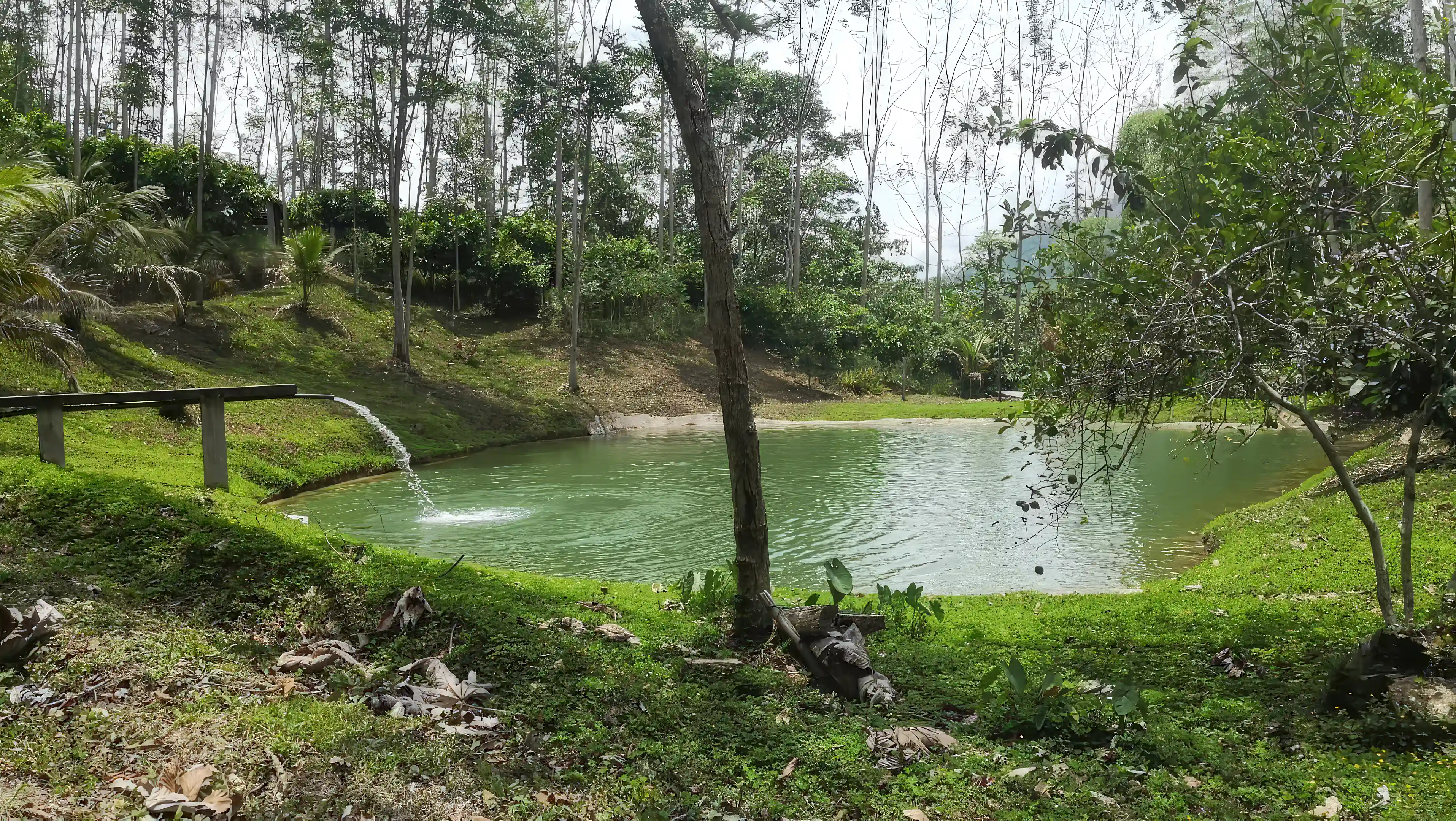
The farm has a new 3-story 5-bedroom casa de campo with a tall shop & garage on the first floor. There is also a hardwood bungalow (with AirBnB potential) overlooking a 25x25m fish pond, and an 8 room guesthouse. As well as assorted other outbuildings.
The 44 hectare farm has 25 hectares of cedro colombiano and 7 hectares of Bolaina Negra (suitable for flooring), along with 6 hectares of oranges and 20 hectares of cacao beneath the cedros. Labour is abundant for ~$20/day. Trustworthy management is available.
44 hectares = 110 acres
The plantation is situated 30 minutes outside Pichanaqui, a dynamic agricultural center for the region (pop. ~60k), and is ~10 hours from Lima, an overnight bus ride to the Amazon side of the Andes. Or a 1 hour flight to nearby Mazamari. Primary agricultural exports from the area include coffee, ginger, citrus, pineapple, bananas etc
The region is called the Selva Central and is the closest tropical jungle to Lima, Peru.
The climate is hot and tropical all year with the farm at 625m asl. 4 creeks on the property, medicinal plants, wildlife (monkeys, parrots etc) and interesting bird watching. Prior to reforestation, the property was a coffee and pineapple plantation.
Cedro plantations like this are uncommon as they are relatively difficult to establish because they need bimonthly spraying for the first three years to combat the mahogany shoot borer moth which will otherwise stunt the trees' growth if left unchecked. Some teak, mahogany, tornillo and other hardwoods planted throughout. As well as mangos, plátanos, avocados, mandarinas, ~100 jackfruit trees etc
To purchase (and register) property in Peru, foreign investors just need show the notary their "permission to sign contracts" stamp in their passport which is easily acquired from the immigration office in central Lima for ~$20 and is good for 90 days.
If you have any questions, feel free to ask!
About This Property
Category
Farms/Ranches
Sold by
Owner
Address
Pichanaqui
Chanchamayo
Peru
Chanchamayo
Peru
Built
2021
Area
44 Hectares
Stories
3
Bedrooms
5
Bathrooms
5
Features - Amenities
- Furnished
- Appliances
- Maid's Quarters
- Maid's Bathroom
- Laundry Room
- Terrace
- Mountain View
- Internet
Pictures (Click to enlarge)


Contact Seller
Owner